
Complete guide · पूरी जानकारी
RRB ALP Psycho Test (CBAT): the five tests, the T-Score 42 rule, and how to prepare
The RRB ALP psycho test is the Computer Based Aptitude Test, CBAT for short. It comes after CBT 2, only for candidates shortlisted for Assistant Loco Pilot. It follows the RDSO guideline (ALPs Guidelines CBT, Jan 2020). You sit five tests: Memory, Following Directions, Depth Perception, Power of Observation and Perceptual Speed, numbered here in the guideline's order; the railway's mock link for CEN 01/2025 runs them as Memory, Depth Perception, Power of Observation, Following Directions and Perceptual Speed. Each test has its own clock and its own T-Score. You need a T-Score of at least 42 in every one of the five. Below 42 in even one test means not qualified, whatever your CBT 2 marks. The CBAT also carries 30% weight in the final ALP merit.
This guide is for a candidate who has never seen the CBAT. It tells you what each of the five tests asks, how the hall screen behaves, and what a T-Score measures. It gives a 30-day plan and what to do on exam day. Each test has its own page, which goes deeper into its kinds and its method. On the Railway Psycho Test Portal of Kautilya Classes you get one free Full Mock after login. Then you can practise every kind with the hall's count and clock. Your T-Score appears as soon as you submit.
RRB ALP का साइको टेस्ट असल में कंप्यूटर आधारित अभिरुचि परीक्षा (CBAT) है, जो CBT 2 के बाद असिस्टेंट लोको पायलट के लिए चुने गए उम्मीदवार देते हैं। इसमें पाँच टेस्ट एक तय क्रम में आते हैं और हर टेस्ट में कम से कम 42 का T-Score लाना ज़रूरी है; किसी एक में भी 42 से कम हुआ तो आप क्वालिफाई नहीं करते, चाहे CBT 2 के अंक कितने भी हों। अंतिम मेरिट में CBAT का वज़न 30% है।
Sit a free Full Mock, on a screen like the hall
All five tests in one sitting, the hall's order and timing, a scorecard out of 30 and your T-Score in each test. Free with every account, no package needed.
पाँचों टेस्ट एक बार में, असली क्रम और समय, हर टेस्ट का T-Score। हर अकाउंट के साथ मुफ़्त।
The five tests and their 20 kinds of questionपाँच टेस्ट
The hall gives one kind of question for each test, with that kind's own count and clock (for 1f, this portal's own setting). ★ marks the kind the railway's mock link for CEN 01/2025 gives. Click a test or a kind for its pattern, a worked example, the method and tips.
| # | Test | Kinds of question (questions · minutes) |
|---|---|---|
| 1 | Memory Testस्मृति परीक्षण |
|
| 2 | Following Directions Testनिर्देश पालन परीक्षण |
|
| 3 | Depth Perception Testगहराई बोध परीक्षण |
|
| 4 | Power of Observation Testअवलोकन शक्ति परीक्षण |
|
| 5 | Perceptual Speed Testप्रत्यक्ष गति परीक्षण |
|
What the CBAT is and when it comes
Candidates call the CBAT the psycho test or the aptitude test. RRB holds it after CBT 2 for the candidates it shortlists for Assistant Loco Pilot. The RDSO guideline fixes the five tests, their order and the kinds each test can take. RDSO is the Research Designs and Standards Organisation of Indian Railways. The names of the five tests say what each one checks: memory, following directions, depth perception, observation and speed.
Three facts matter. First, it is qualifying. You need a T-Score of 42 or more in each of the five tests. Second, it is not only qualifying. The CBAT carries 30% weight in the final ALP merit, and CBT 2 Part A carries 70%. A higher T-Score lifts your rank, so 42 is the floor, not the goal. Third, there is no negative marking in the CBAT, so a blank answer can only lose. The screens and the questions come in Hindi and English together. Language is not a barrier; speed and attention are.
The five tests, as the guideline numbers them
The RDSO guideline numbers the five tests in this order. Test 1, the Memory Test: you study a map, pairs or shapes while a clock runs, then answer from memory. Test 2, the Following Directions Test: a table of letters or numbers, or a watch-like circle, stays on screen. Each question is a direction to follow across it. Test 3, the Depth Perception Test: a pile of bricks or blocks drawn in three dimensions. You count the ones touching a lettered brick, or the ones hidden on every side. Test 4, the Power of Observation Test: compare two numbers, find a digit among groups, or spot moved figures. Speed is everything. Test 5, the Perceptual Speed Test: one figure on the left, five on the right, find the match. The railway's mock link for CEN 01/2025 runs them as Memory, Depth Perception, Power of Observation, Following Directions and Perceptual Speed; the test numbers on this site follow the RDSO guideline, and the free Full Mock sits them in the mock's order.
Each test has several kinds, 20 in all, and the hall gives only one kind of each test. You do not know in advance which kind, so prepare every kind. The table on this page lists every kind. In the last exam (CEN 01/2024) the hall gave Figure Find, Watch Table, Hidden Cube, Figure Placement and Same Figure Tests. That is what the institute's records show, not a promise for next time. For CEN 01/2025 the railway's own mock link shows the kind of each test: Vehicle & Signal Position (1f), Watch Table (2b), Brick (3a), Figure Placement (4d) and Octagonal (5b), marked ★ in the table. Practise those five first. The kinds of one test share a skill, but each has its own screen and its own trap. The count and clock are not the same for every kind.
T-Score 42: what it means
Your result in each test is a T-Score, not a count of right answers. The T-Score compares you with everyone who sat the same paper. On this scale 50 is the average candidate, and every 10 points is one standard deviation. So 60 means clearly better than most of the group, and 40 clearly worse. That puts 42 a little below the average candidate. To qualify, you need to be near the middle of the group, not at the front. But you must do this in all five tests separately. A 60 in the Memory Test does not rescue a 40 in the Depth Perception Test.
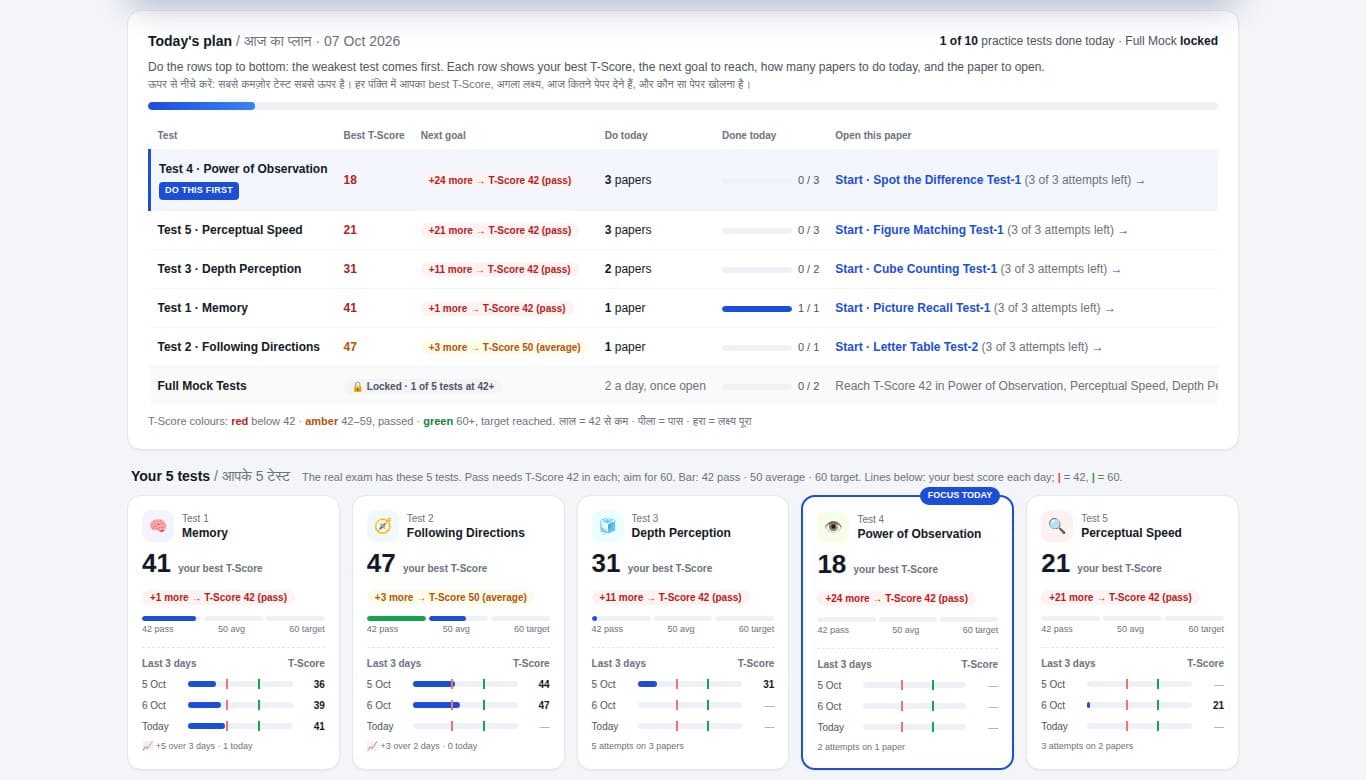
Because the score is relative, nobody can say in advance how many right answers make 42. It depends on the rest of the group. So the portal reports a T-Score, not a percentage, after every practice paper and every Full Mock. Kautilya Classes sets a target of T-Score 60 in every test; 42 is only the pass bar. Aiming at 60 leaves a margin for a hard paper or a slow start. The Full Mock scorecard is out of 30 and shows the T-Score of each test. One look shows which test holds you back.
How the hall screen works
Every test opens with an instruction screen in Hindi and English. It shows a worked example, which tells you the kind. Read it even after much practice: the example confirms which kind the hall has chosen. Then the test starts and its own Time Left clock begins. You answer and press Save & Next to move on. When the clock reaches zero the screen submits for you, finished or not. In a Full Mock a short break with a summary comes between tests, then the next instruction screen. In the Memory Test, study parts come before test parts, each with its own clock.
The portal's screen is built to behave the same way, as per the RDSO pattern. Its instruction screen allows 5 minutes and can be skipped once you know the kind. Every practice paper has the hall's count and clock, and Save & Next works the same. One difference matters. The hall is a desktop with a mouse. The portal runs on a phone, but there the figures are smaller and you tap instead of clicking. Sit your papers and Full Mocks on a laptop or desktop whenever you can.
How to prepare in 30 days
Thirty days go a long way if every day has a job. Start with measurement, not practice. Sit the free Full Mock on the first day and read the scorecard. It tells you which of the five tests is below 42 and which is below 60. Then spend most of the month on practice papers of the kinds in your weakest two tests. A paper allows up to 3 attempts, and the highest T-Score of the attempts counts. So a second attempt after reviewing the solutions is worth more than a new paper done blind. Review every wrong answer and every blank. In the last week return to Full Mocks in the hall's order, so five tests in a row feel familiar. These come with the Full Mock package or the Combo.
Exam day
Read every instruction screen to the end, even when you know the kind at a glance. In the Memory Test, use the whole study part, even if you feel ready. When a test part starts, work in order and press Save & Next after every answer. Keep one eye on Time Left. If the clock is about to run out, answer the remaining questions quickly: a blank is a sure zero. Use the moment before the next test to breathe, not to replay the last one. Each test gets its own T-Score. Treat each test as a fresh start.
Two habits from practice carry into the hall. First, the mouse. Your hand should already know the path from the option to Save & Next, because you practised on a desktop. Second, the rhythm. Every kind has its own pace, fast in the Yes or No Test and slower in the Hidden Cube Test. If you have sat each kind with the hall's clock, your body keeps that pace on its own. When a question stumps you, give your most likely answer and move on. Lingering on it costs more than it earns.
What T-Score 42 means on the portalT-Score का मतलब
The portal scores every paper the same way the railway does, against everyone who sat it, so the number you see in practice is the number that matters in the hall.
The 30-day plan30 दिन की योजना
| Days | What to do |
|---|---|
| Days 1 to 3 | Sit the free Full Mock on a laptop, in one sitting, in the hall's order. Note the T-Score of each test. Read the page of each test once. |
| Days 4 to 9 | Practice papers of every kind in your weakest test, one or two a day. Review each wrong answer the same day, then take the second attempt. |
| Days 10 to 18 | Add the second weakest test. Keep every kind of both tests in rotation, so no kind is a surprise. Aim: every paper at 42 or more. |
| Days 19 to 24 | Papers from all five tests, lighter in the strong ones. One Full Mock in this stretch to check nothing has slipped. Aim: 60 in the weak tests. |
| Days 25 to 30 | A Full Mock every second day, with the hall's timing and the breaks, on a desktop. Between them, short reviews only. Rest on the last day. |
Questions students askसवाल-जवाब
▸What is the RRB ALP psycho test?
It is the Computer Based Aptitude Test (CBAT) for Assistant Loco Pilot, held after CBT 2 for the candidates RRB shortlists. It has five tests, each with its own clock and T-Score, and follows the RDSO guideline.
▸How many tests are there in the ALP CBAT, and in which order?
Five: Memory Test, Following Directions Test, Depth Perception Test, Power of Observation Test and Perceptual Speed Test, numbered here in the RDSO guideline's order. The railway's mock link for CEN 01/2025 runs them as Memory, Depth Perception, Power of Observation, Following Directions and Perceptual Speed. Each appears as one of its kinds; there are 20 kinds in all.
▸Which kinds came in the last RRB ALP psycho test (CEN 01/2024)?
The institute's records show one kind of each test. They are 1e Figure Find, 2b Watch Table, 3b Hidden Cube, 4d Figure Placement and 5e Same Figure. For CEN 01/2025 the railway's mock link shows different kinds for three of the tests; see the next question.
▸Which kinds will come in the RRB ALP psycho test for CEN 01/2025?
The railway's own mock link for CEN 01/2025 shows one kind of each test: Vehicle & Signal Position (1f) for the Memory Test, Brick (3a) for Depth Perception, Figure Placement (4d) for Power of Observation, Watch Table (2b) for Following Directions and Octagonal (5b) for Perceptual Speed. The mock runs the tests in that order, as the free Full Mock here does, and says the question count and clock of each will vary in the actual exam. Practise these five first, and keep the other kinds ready.
▸What is the T-Score in the ALP CBAT?
The T-Score compares you with everyone who sat the same paper. 50 is the average candidate, and every 10 points is one standard deviation. A 60 is comfortably above the average; 42 is a little below it.
▸How much does the CBAT count in the ALP final merit?
30%. The final merit for ALP takes 70% from CBT 2 Part A and 30% from the CBAT. Merit is counted only for candidates who qualify in all five tests. Good CBT 2 marks cannot rescue a weak test.
▸Is the ALP psycho test in Hindi or English?
Both. The instruction screens and the questions show Hindi and English together. The tests are mostly figures, letters, numbers and short directions, so looking speed matters more than reading speed.
▸How long does the whole psycho test take?
Each test runs on its own clock, from 4 minutes for the shortest kinds to 12 for the longest. Added up, the five clocks give between 27 and 47 minutes of test time, depending on the kinds. The combination of CEN 01/2024 added up to 43 minutes. Instruction screens come on top, so plan on five separate clocks, not one figure.
सारांश (हिंदी में)
RRB ALP का साइको टेस्ट यानी CBAT, CBT 2 के बाद चुने गए उम्मीदवारों की कंप्यूटर पर होने वाली परीक्षा है, जो RDSO की गाइडलाइन के अनुसार होती है। इसमें पाँच टेस्ट तय क्रम में आते हैं: स्मृति, निर्देश पालन, गहराई बोध, अवलोकन शक्ति और प्रत्यक्ष गति; हर टेस्ट परीक्षा हॉल में अपने किसी एक प्रकार में आता है और उसकी अपनी घड़ी होती है। हर टेस्ट में कम से कम 42 का T-Score ज़रूरी है, और अंतिम मेरिट में CBAT का वज़न 30% है। तैयारी की शुरुआत मुफ़्त फुल मॉक से करें, फिर कमज़ोर टेस्ट के प्रैक्टिस पेपर रोज़ करें और हर गलत सवाल को दोबारा देखें। लक्ष्य हर टेस्ट में 60 का T-Score रखें, ताकि कठिन पेपर में भी आप सुरक्षित रहें।